We previously described a computerized algorithm
that diagnosed and graded detrusor
instability [1]. To further validate
this method, we applied it to patients
treated with sacral neuromodulation.
The instability parameters calculated
from the cystometric studies of
implanted patients before and 6
months after the operation were
compared. In addition, the changes
in the parameter values were correlated
with symptomatic changes as derived
from voiding / incontinence diaries.
Methods
Neuromodulation is applied at our department
since 1990. Voiding / incontinence
diaries and cystometric studies
at baseline and after 6 months are
part of the evaluation. Cystometry
is done in the supine and standing
position and, after implantation,
with the stimulator on and off.
From 1993 onwards, cystometric data
is sampled and stored using PC’s.
Only those patients in whom the
cystometric studies at baseline
as well as after 6 months were stored
were included in the present study.
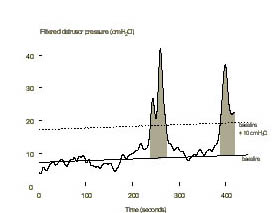
The data was processed as follows (Figure):
Two points of the filtered (0.10
Hz low pass filter) detrusor pressure
signal were selected manually and
a straight line representing the
passive detrusor pressure baseline
was drawn. The active detrusor pressure
was defined as the total detrusor
pressure minus the baseline pressure
value. All detrusor pressure values
exceeding the baseline by more than
10 cm H2O were added
and divided by the sample frequency
to approximate the area between
the detrusor pressure signal and
the baseline. This area was called
the area of instability (shaded
area in figure). Other parameters
derived included the total duration
of the unstable episodes, the amplitudes
of the first and the maximum unstable
contraction and the corresponding
bladder volumes, the mean active
pressure during the unstable episodes
and the bladder capacity. When no
instability was found with this
procedure, that is, when the constructed
detrusor pressure baseline was not
exceeded by more than 10 cm H2O,
the area of instability was set
equal to 0.
The pretreatment measurements in the standing position
were compared with the posttreatment
measurements in the standing position
with the neurostimulator on. Three
categories of symptomatic success
were defined:
a more than 90% decrease in the
number of pads used per day or the
number of incontinence episodes
per day was considered a cure, a
decrease between 50 and 90% was
considered a partial success and
a decrease of less than 50% was
considered a failure.
Results
The
filling phase was sampled and stored
on computer disk before and after
treatment in 26 consecutive patients
(22 women and 4 men) with a mean
age of 44 years. The program and
the urodynamic report (ICS criteria
for the definition of instability
were used) agreed on the presence
or absence of unstable contractions
in 51 out of the 26x2 measurements
considered. All the above-mentioned
parameters responded favourably
to neuromodulation, but statistical
significance (paired t-test) was
only achieved for the amplitudes
of the first and the maximum unstable
contraction, the mean active pressure
during unstable episodes and the
maximum detrusor pressure. The bladder
was stable at follow-up in 7 women
and 1 man. Of these patients, 5
(63%) were symptomatically cured,
1 (13%) was a partial success and
2 (25%) were failures. In the 18
patients whose bladder remained
unstable, these numbers were: 10
(56%), 5 (28%) and 3 (17%). These
distributions were not significantly
different (Pearson chi-square: p=0.67).
On average, the baseline cystometric
parameters were more favourable
in the females whose bladder became
stable than in the ones whose bladder
remained unstable, but the difference
was only significant (unpaired t-test)
for the amplitude of the maximum
unstable contraction and the mean
active pressure during unstable
episodes. No significant differences
(Kruskal-Wallis test and Mann-Whitney
U test) between any of the baseline
parameters in the 3 groups of females
with a varying degree of symptomatic
success were found. The changes
in the cystometric parameters and
those in the number of incontinence
episodes per day and the number
of pads used per day did not correlate
significantly.
Conclusions
The
described algorithm accurately diagnoses
bladder instability. The responses
of the calculated parameters to
neuromodulation support its validity.
In our patient group, neuromodulation
on average reduced the amplitudes
of the unstable contractions but
did not change the volumes at which
they occurred. Females who had a
stable bladder at follow-up on average
initially suffered from a less severe
grade of instability. Cystometric
parameters could however not predict
the symptomatic outcome of treatment,
which is apparently also dependent
on factors unrelated to the urodynamic
status.
[1]. J.Urol. 159: 1669-1674,
1998.


